


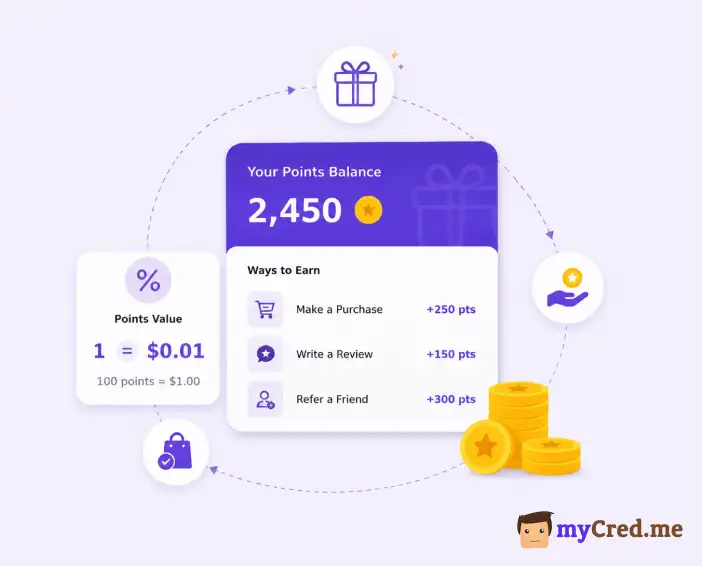
Most stores start with 1 point per dollar spent. But that number only works if you know what a point is worth when it gets redeemed. Get that part wrong, and you’re either giving away margin you can’t afford or handing out points nobody bothers to collect.
This blog explains how many loyalty points should you give to customers, plus bonus structures, tiers, and redemption thresholds you can copy.
What Determines How Many Points You Should Give?
Three numbers decide this: your profit margin, your average order value, and what each point is worth at redemption. Get those three rights and the “how many points” question answers itself.
Most people skip straight to picking a ratio. They see a competitor giving 1 point per dollar and copy it. That’s backwards. The ratio should come from your numbers, not from what looks normal.
Your profit margin per sale
This sets your ceiling. If you’re running on 10% margin, you can’t afford to give back 8% of that order in rewards. You’d be working for free on every redemption.
Check your margin first. Everything else in this guide depends on it.
Your average order value (AOV)
Points feel meaningful when they add up to something in a reasonable number of purchases. If your AOV is $30, a program that takes 20 orders to earn a $5 reward will feel pointless. Customers won’t track it, and won’t come back for it.
Look at how often your average customer buys, then work out how many points they’d realistically rack up in that window.
Your redemption value per point (the number everything else depends on)
This is the one number you actually need to decide before anything else. What is 100 points worth in dollars off a future order?
Once you fix that, your earn rate becomes simple math. If 100 points = $5, and you want customers earning that $5 reward roughly every $50 spent, you know your points-per-dollar ratio.
The core formula:
Points earned per dollar × redemption value per point ≤ the percentage of revenue you’re willing to give back in rewards
Set the right side first. Then work backward.
How to Calculate Your Points-to-Dollar Ratio
Pick a reward value first, then reverse-engineer the earn rate. Most stores get this backwards and end up guessing.
Step 1: Decide what 100 points should be worth in dollars
Don’t start with “how many points per dollar.” Start with the payoff. Say $5 off a future order. That’s a number customers understand without doing math in their head.
Once that’s fixed, everything else follows from it.
Step 2: Reverse-engineer the earn rate from that
Now work out how much a customer needs to spend to hit that 100-point reward. If you want them there after roughly $50 in purchases, you’re looking at 2 points per dollar. If you want it to take $100, that’s 1 point per dollar.
There’s no universal right answer here. It depends on how often people buy from you and how much you’re willing to give back.
Step 3: Stress-test it against your lowest-margin product
Take your cheapest, lowest-margin item. Run the math on what happens if someone buys only that, earns points, and redeems them on another low-margin item.
If that scenario loses you money, your ratio is too generous. Adjust before you launch it, not after.
Worked example:
A store sells a $25 average order at 8% margin. That’s $2 profit per order. They want rewards to cost no more than a third of that margin, so about $0.65 per order in redemption value.
At 1 point per dollar, a $25 order earns 25 points. If 100 points = $5, then 25 points = $1.25. That’s too high against a $0.65 target.
Drop the redemption value to 100 points = $2.50, and the same order now costs $0.625 in rewards.
This is the exercise. Set the target margin give-up, then adjust the ratio until the math holds at your real order size.
Points-to-Currency Ratio Examples by Business Type
There’s no single ratio that works everywhere. A grocery store and a SaaS company can’t run the same numbers, because their margins aren’t close.
| Business type | Typical margin | Common ratio | Redemption value |
|---|---|---|---|
| Low-margin retail (grocery, consumables) | 2-5% | 1 point per $2-5 spent | 100 points = $1-2 |
| Mid-margin ecommerce (apparel, home goods) | 30-50% | 1-2 points per $1 spent | 100 points = $5 |
| High-margin digital/SaaS | 70-90% | 5-10 points per $1 spent | 100 points = $10-15 |
| Subscription boxes | 40-60% | Flat points per billing cycle | Points = credit toward next box or upgrade |
If you’re not sure which bracket you’re in, work out your actual margin before picking a ratio.
How to Set a Reward Value That Stays Profitable
Cap your loyalty points reward value as a percentage of order value, not as a flat number. A flat discount that works on a $100 order can wipe out your margin on a $20 one.
Cap redemption value as a percentage of order value, not a flat number
Say you decide rewards should never cost more than 3% of an order’s value. That percentage holds steady whether the order is $20 or $200. A flat “$5 off” doesn’t scale the same way.
It’s a rounding error on a big order and a real hit on a small one.
Set the cap as a percentage first. Let the dollar amount move with the order.
Why “too generous” backfires
If you’re giving back 15% of revenue in points, you’re not running a loyalty program anymore. You’re running a discount program that happens to have a delay built in.
Generous programs also train customers to wait for point-heavy purchases instead of buying at full value. You end up funding behavior you didn’t intend to pay for.
Why “too stingy” backfires
Go too low and the program stops mattering. If it takes $500 in spend to earn $2 off, nobody’s going to track it. You’ll have built a system that costs you money in tracking and marketing, with no behavior change to show for it.
A program only works if customers can feel the reward. If they can’t, you’re paying for a feature nobody uses.
The sweet spot
Most profitable loyalty programs land between 1% and 5% of revenue given back in rewards, depending on margin. Low-margin businesses sit near the bottom of that range. High-margin ones can push toward the top and still come out ahead.
Pick a number in that range, check it against your own margin, and adjust from there.
First-Purchase Bonus Loyalty Points: How Much Is Enough?
Give new customers 2-3x your normal earn rate on their first order. It’s not about the math on that one sale. It’s about getting them to make a second one.
Why first-purchase bonuses exist
A first purchase alone doesn’t build a habit. The bonus isn’t meant to pay for itself immediately. It’s there to make the points balance feel like something worth coming back for, right out of the gate.
Think of it as a customer acquisition cost, not a loyalty cost. You’re not trying to profit on order one. You’re trying to earn order two.
Typical bonus size relative to standard earn rate
If your standard rate is 1 point per dollar, a first-purchase bonus might land at 2-3 points per dollar, or a flat bonus like “500 points on your first order” regardless of order size.
A flat bonus works well when you want new customers to see a big, round number right away. A multiplier works better when you want the bonus to still feel connected to what they spent.
Example structure
A store selling $30 average orders gives 1 point per dollar normally, but 100 bonus points on the first purchase. That first order earns 130 points instead of 30. If 100 points = $5, the new customer is sitting close to their first reward after one purchase instead of three or four.
That’s the point. Get them close enough to a reward that finishing the gap feels worth a second visit.
Repeat-Purchase Bonus Loyalty Points
Give more points on the second, third, and fourth purchase than on the first. That’s when the habit either forms or doesn’t, and it’s worth paying extra to lock it in.
Why repeat-purchase bonuses matter more than they look
A single purchase doesn’t prove loyalty. It proves someone was willing to try you once.
Members who redeem more than once, across more than one category, spend 3.9x more on average than members who have never redeemed.
That gap is the whole argument for weighting your bonus structure toward the second and third purchase, not just the first.
Members already spend more than non-members too. Enrolled customers spend 12% to 18% more than non-members, but that number only holds if they stay active. Nector
A points balance sitting untouched isn’t loyalty. It’s a customer who signed up and left.
Escalating rewards for the 2nd, 3rd, and 4th purchase
A simple structure: 1x points on the first order, 1.5x on the second, 2x on the third. Each step gives a reason to come back sooner rather than later.
This also protects against the most common failure mode in points programs: unspent balances.
27% of loyalty points go unspent, which means a big share of programs are handing out points that never turn into a second visit. Escalating bonuses give customers a reason to keep going instead of letting the balance sit.
Time-boxed repeat bonuses
Add a deadline. “Buy again within 30 days and earn double points” does two things at once: it sets a redemption target and creates urgency around it. Programs that pair rewards with automated nudges near a redemption threshold see this play out directly.
One of the highest-converting loyalty messages is simply telling someone they’re 50 points away from a $10 reward.
Illustrative example
A store might run: standard order earns 1 point per dollar. A second purchase within 30 days earns 1.5x. A third within 60 days of the first earns 2x. After that, the customer moves to a standard repeat-customer rate.
Product-Specific Point Boosts
Boost points on specific SKUs when you want to move overstock, launch something new, or protect margin on your best sellers. It’s targeted, not a blanket increase.
When boosted points make sense
The logic here is different from a store-wide multiplier. You’re not trying to move everyone.
Boosting points on high-margin SKUs is one of the more direct ways to use a loyalty structure to steer purchases toward the items that are actually worth steering toward. Nector
A markdown or a boosted-points banner both catch attention, but the points boost doesn’t cut into your listed price.
How to avoid training customers to only buy boosted items
Keep boosts occasional and specific. A category, a launch window, a clearance run. Not a permanent feature of how customers shop with you.
Illustrative example
“2x points on outdoor gear this month” works because it’s bounded. Customers know it ends, and the base program still functions normally once it does.
Setting a Minimum Redemption Threshold
Set your threshold so a typical customer hits their first reward within 2 to 3 purchases. Any longer than that and most members disengage before they redeem anything.
Why thresholds exist
A threshold isn’t just an admin setting. It’s what turns “I have some points” into “I’m buying again to use them.”
Design your earn rate and threshold so a typical customer reaches their first reward within 60 to 90 days, across 2 to 3 purchases. That first redemption matters more than the ones after it. It’s what turns a passive member into someone who actually checks their points balance.
There’s research behind this too. A well-known study on loyalty programs found something counterintuitive.
Researchers gave one group of customers an 8-stamp card starting empty, and gave another group a 10-stamp card that already had 2 stamps filled in. Both groups needed the same 8 purchases to earn the reward.
But the group that started with 2 stamps already done finished at a noticeably higher rate than the group starting from zero. A head start, even a fake one, made people more likely to see the goal through.
That’s the logic behind a welcome bonus. It makes the first reward feel closer and worth chasing, instead of a distant target they haven’t started toward.
How to calculate a threshold that feels achievable
One method: set the threshold near 20% of your average transaction value.
A customer sitting on points worth $5 tends to spend around $25 to use them. Raise the threshold to require $20 in accumulated value, and that same customer is inclined to spend closer to $100 to unlock it.
If your threshold is too high relative to how often people actually buy, the fix isn’t always to lower it. Sometimes it’s better to add more ways to earn points, like reviews, referrals, and social shares.
A working range
For most stores, a threshold reachable within 2-3 typical orders keeps the program active without giving away loyalty points and rewards too easily. Go much beyond that and most customers never redeem at all, which defeats the point of running the program.
Example Loyalty Points Structures
Three starting configurations, based on the frameworks above. Adjust the specific numbers to your own margin and AOV before using any of these.
Example 1 — Low-margin retail store
- Earn rate: 1 point per $2-5 spent (tight ratio, since margin is thin)
- Redemption value: 100 points ≈ $1-2
- First-purchase bonus: modest flat bonus, enough to get partway to the first reward without eating into margin
- Minimum threshold: set near 20% of average transaction value
- Repeat-purchase bonus: small multiplier on the second purchase to encourage a fast repeat, since margin doesn’t allow for large multipliers
Example 2 — Mid-margin ecommerce store
- Earn rate: 1-2 points per dollar spent
- Redemption value: 100 points ≈ $5
- First-purchase bonus: 2-3x standard rate, or a flat bonus that puts new members close to their first reward
- Minimum threshold: reachable within 2-3 typical orders
- Tier structure: 3 tiers, with the top tier earning roughly 2x the base rate
Example 3 — High-margin digital/subscription store
- Earn rate: 5-10 points per dollar spent, since margin supports generosity
- Redemption value: 100 points ≈ $10-15
- First-purchase bonus: can afford to be aggressive here, given the margin cushion
- Minimum threshold: can sit lower relative to spend, since the cost per reward is small next to what the sale earned
- Bonus campaigns: time-limited multipliers work well here without threatening profitability
Last Word
Know your numbers before you pick a ratio. Margin, AOV, redemption value. Once you’ve decided on an earn rate, a threshold, and a tier structure, you need a loyalty plugin that actually runs it the way you designed it, without you manually tracking who earned what.
That’s what myCred handles. Points-per-action rules, tiered ranks, time-limited bonus campaigns, minimum redemption thresholds. All of it configurable without needing a developer for every change.
If you’re ready to see how the earn-rate math in this post translates into actual plugin settings, myCred’s points-per-action documentation is the place to start.