


A loyalty program works by rewarding customers for actions that matter to a business. Customers may earn points for purchases, referrals, reviews, or other activities. They can then use those points for discounts, products, perks, or other rewards.
For online stores, the process can happen automatically. A customer places a qualifying order, the loyalty program system checks the rules, awards the right number of points, and updates the customer’s account.
Here, we’ll break down how a loyalty program works, how loyalty points are earned and redeemed, and how the same process works for WordPress and WooCommerce websites.
How Does a Loyalty Program Work?
A loyalty program works by connecting customer actions with rewards.
A customer completes a qualifying action, the system checks the program rules, and the customer receives points or another benefit. Those rewards can later be redeemed based on the program’s rules.
The loyalty program process usually has six steps:
- The customer joins the program.
- The customer completes a rewardable action.
- The system calculates the reward.
- The customer accumulates points or benefits.
- The customer redeems the reward.
- The reward gives the customer a reason to return.
The exact rules can vary. What matters is the connection between the action and the reward.
For example, imagine a WooCommerce store that gives one point for every dollar spent. A customer spends $100 and earns 100 points. Once they reach 500 points, they can exchange those points for a $25 discount.
The customer gets a reward for spending. The store gets another reason to bring that customer back.
1. The Customer Joins the Program
The process starts when a customer becomes part of the loyalty program.
On an online store, this may happen when the customer creates an account. Some programs may enroll customers after their first purchase or let them join through a separate sign-up form.
The system needs a way to connect rewards with the right customer. This is usually done through a customer account, email address, or another unique identifier.
Once the customer is enrolled, the program can track qualifying actions and update their reward balance.
2. The Customer Completes a Rewardable Action
Next, the customer does something that the business has decided to reward.
The most common example is a purchase. But loyalty programs can reward many other actions, such as:
- Creating an account
- Buying a product
- Spending a certain amount
- Making another purchase
- Writing a product review
- Referring a new customer
- Reaching a spending milestone
- Completing a specific activity
This is important because a loyalty program is not simply about giving away points. It should connect rewards with actions that have value to the business.
For example, if repeat purchases are the main goal, the program may reward customers for buying again. If referrals are more valuable, the program may give points when a referred customer makes a purchase.
3. The System Calculates the Reward
After the customer completes an eligible action, the loyalty system checks the rules.
It determines whether the action qualifies and how much the customer should receive.
For example:
Rule: Earn 1 point for every $1 spent.
Customer purchase: $75
Reward: 75 points
The calculation can also be more specific. A store might offer 2 points per dollar for selected products or give 100 bonus points during a promotional period.
How Do Loyalty Points Work?
Loyalty points are units a business gives customers for completing qualifying actions. Customers collect those points and can later exchange them for rewards according to the program’s rules.
The points themselves do not have a universal value. Each business decides how customers earn them and what they can get in return.
For example:
- Spend $1 → Earn 1 point (as you can see below in the myCred’s backend hook settings)

- Earn 100 points → Get $5 off
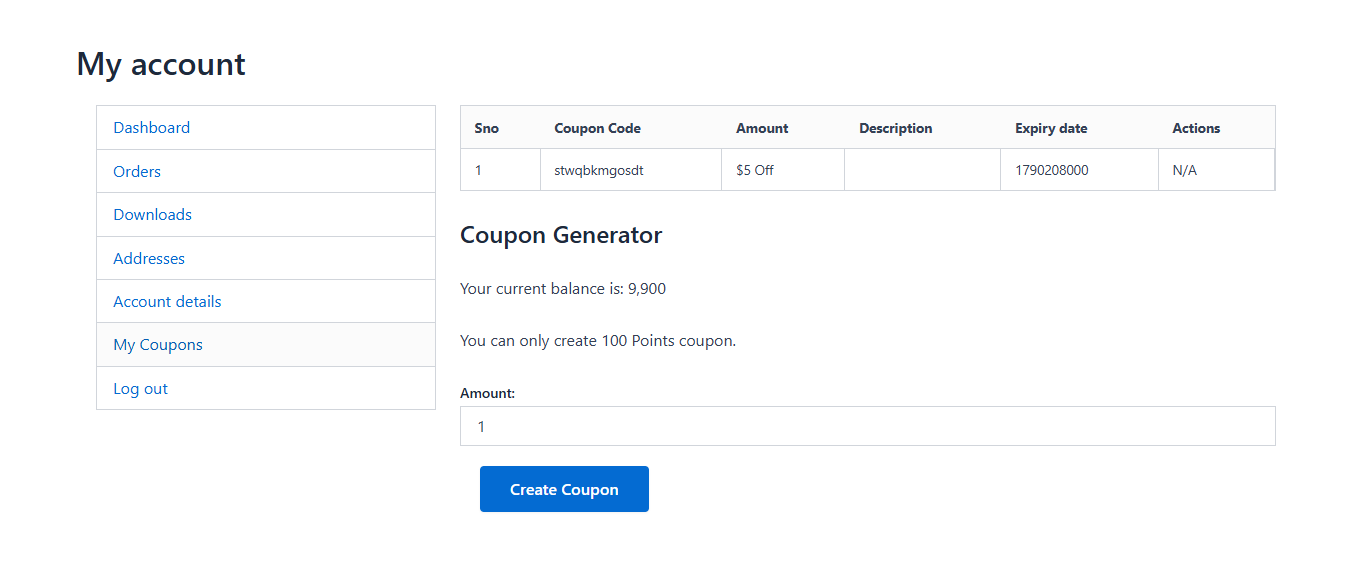
- Refer a customer → Earn 50 points
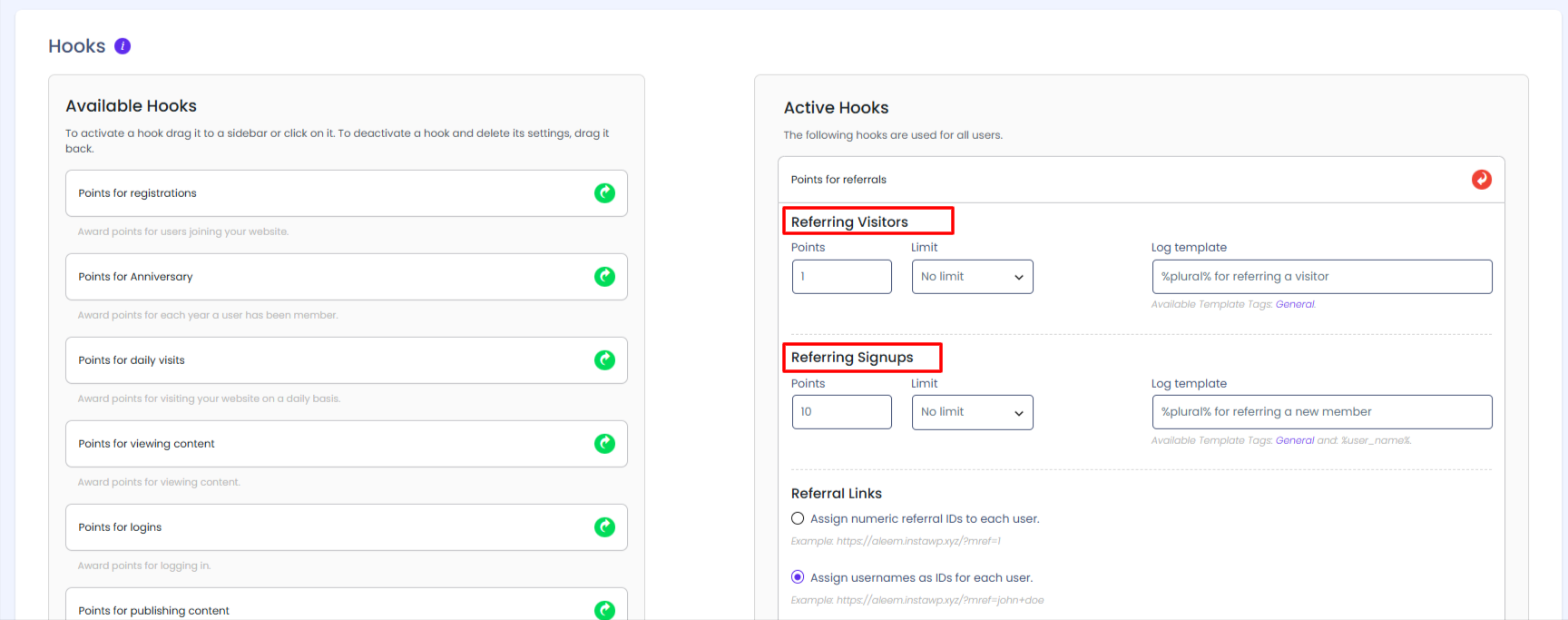
- Reach 1,000 points → Earn a special reward
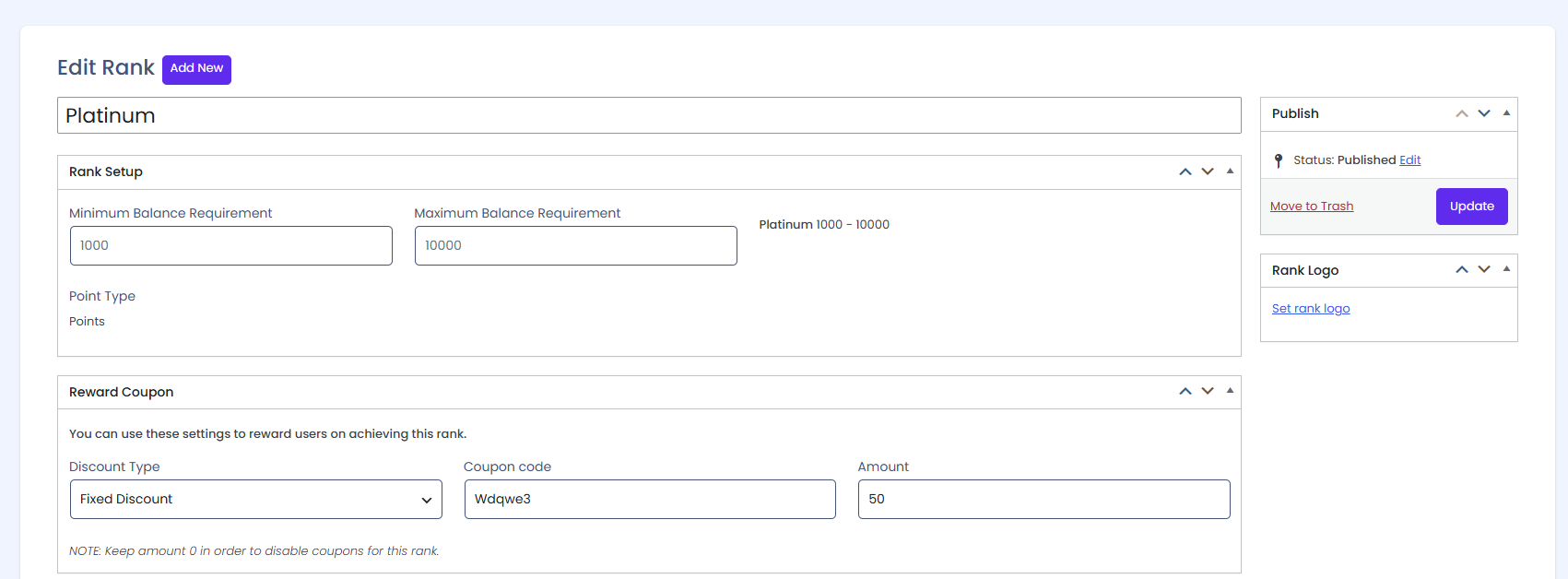
This creates a simple exchange between customer behavior and value.
A customer takes an action. The business records it. The loyalty system awards points. The customer keeps collecting points until they can use them.
How Businesses Decide the Value of Points
There is no standard conversion rate for loyalty points.
One business may set:
100 points = $1
Another may set:
500 points = $10
The business also decides how many points customers need before they can redeem a reward.
Other rules may apply too. A business can:
- set a minimum redemption amount,
- limit which products qualify, or
- make certain rewards available only to specific customers.
These rules determine the real value of the points. That is why customers need clear earning and redemption rules.
How Does a Loyalty Program Work for an Online Store?
A loyalty program for an online store connects customer activity with an account-based reward system. When a customer completes a qualifying action, such as placing an order:
- the loyalty system records the action,
- applies the program rules, and
- adds the appropriate reward to the customer’s account.
For a typical ecommerce store loyalty program, the process looks like this:
Customer places order → Order qualifies → Loyalty rules are checked → Points are calculated → Points are added → Customer sees updated balance
Consider a WooCommerce store that awards 1 point for every $1 spent.
A customer places a $120 qualifying order.
The loyalty system checks the order and awards 120 points. The customer’s account now shows the new balance. Those points can later be redeemed if the customer meets the program’s redemption requirements.
The process can also involve actions beyond purchases.
An online store might reward:
- First-time account creation
- Product reviews
- Referrals
- Repeat purchases
- Specific products
- Spending milestones
- Promotional activities
What Happens After an Online Purchase?
The exact process depends on the loyalty system, but the basic workflow is straightforward.
1. The customer places an order.
The ecommerce platform records the order and its details.
2. The system checks whether the order qualifies.
Some programs only reward completed or eligible purchases. Cancelled, refunded, or excluded orders may not qualify under the program’s rules.
3. The reward is calculated.
The system applies the configured earning rule to the qualifying activity.
4. The reward is added to the customer’s account.
The customer’s points balance and transaction history are updated.
5. The customer can track their progress.
A loyalty interface may show the current balance, available rewards, and transaction history.
6. The customer redeems the reward when eligible.
The system checks the redemption rules before applying the reward.
This is what makes an online loyalty program different from manually handing out discount codes. The earning and tracking process can be connected directly to customer activity.
Can an Online Store Reward Actions Other Than Purchases?
Yes. A loyalty program can reward any action supported by its rules and technical setup.
For example, a store may award points for a product review because reviews can provide useful customer feedback and social proof.
It may reward referrals because successful referrals can bring new customers.
The key is to define the action clearly and specify exactly when the reward is issued.
A good rule can be:
Complete a qualifying product review → Earn 50 points
How Do Different Types of Loyalty Programs Work?
Different loyalty programs use different reward models, but the basic process stays the same. A customer completes a qualifying action, the program records it, and the customer receives a reward or benefit based on the program’s rules.
The main difference is what customers earn and how they earn it.
Points-Based Loyalty Programs
A points-based program gives customers points for specific actions. Customers collect those points and redeem them for rewards.
For example:
Spend $1 → Earn 1 point → Reach 500 points → Redeem a $5 reward
Tiered Loyalty Programs
A tiered loyalty program gives customers different benefits based on their level of activity or spending.
For example:
- Bronze: 1 point per $1 spent
- Silver: 1.5 points per $1 spent
- Gold: 2 points per $1 spent
The goal is to give customers an additional reason to reach the next level.
Cashback Loyalty Programs
A cashback loyalty program returns part of a customer’s qualifying spend as cashback.
For example, a store may offer:
Spend $100 → Receive $5 cashback
Paid or Membership-Based Programs
A paid loyalty program requires customers to pay a fee to access specific benefits. Those benefits may include:
- Exclusive discounts
- Free shipping
- Early access
- Member-only products
- Special rewards
Punch-Card Loyalty Programs
A punch-card program rewards customers after they complete a set number of purchases or visits.
For example:
Buy 9 times → Get the 10th purchase free
Referral-Based Loyalty Programs
A referral loyalty program rewards customers for bringing new customers to a business.
A typical process looks like this:
Customer shares referral → New customer completes qualifying action → Referral is confirmed → Existing customer receives reward
These models can also be combined. For example, a WooCommerce store could use points for purchases, bonus rewards for referrals, and tiers for high-value customers.
The model matters less than the rules behind it. Customers should understand what they need to do, what they will receive, and how they can use it.
How Do Loyalty Programs Encourage Repeat Purchases?
Loyalty programs can encourage repeat purchases by giving customers an additional benefit for returning. After a purchase, customers can see progress toward a reward, which can give them a reason to make another qualifying purchase.
The basic cycle is:
Purchase → Earn reward → Build progress → Redeem reward → Return
Progress Gives Customers a Reason to Return
A visible points balance can show customers how close they are to their next reward.
For example, a customer with 450 points may need only 50 more points to reach a 500-point reward.
That creates a clear next step.
Rewards Add Value to Another Purchase
A loyalty reward can make a future purchase more valuable to the customer.
Suppose a customer has earned enough points for a $10 discount. They may choose to return to the same store rather than buy from another store where they have no accumulated rewards.
The reward does not guarantee another purchase. It simply gives the customer an additional reason to consider one.
Loyalty Programs Can Reward More Than Spending
Repeat purchases are not the only behavior a loyalty program can encourage.
A business may also reward:
- Referrals
- Product reviews
- Repeat visits
- Account activity
- Higher spending
- Specific products
- Milestones
This lets the business decide which customer behaviors are worth rewarding.
Loyalty Rewards Can Create a Repeat Cycle
A well-structured program creates a simple loop:
Customer acts → Customer earns → Customer sees progress → Customer redeems → Customer returns
After redemption, the customer’s balance changes and the cycle can begin again.
The goal is to create a clear exchange. Customers receive meaningful rewards, while the business encourages actions that have real value.
What Happens Behind the Scenes of How Does a Loyalty Program Work?
Behind every loyalty program is a set of rules that connects customer actions with rewards. The system records an action, checks whether it qualifies, calculates the reward, updates the customer’s balance, and records the transaction.
The basic workflow is:
Customer activity → Trigger → Rule check → Reward calculation → Balance update → Redemption
Customer Activity
The process starts with an action. This could be a purchase, referral, review, account registration, or another supported activity.
The system needs to identify the customer and record what happened.
Loyalty Reward Rules
The system then checks the program’s rules. For example:
Rule: Earn 10 points for every $10 spent.
If the customer makes a qualifying $50 purchase, the system knows that the customer should receive 50 points.
Loyalty Reward Calculation
The loyalty system calculates the reward based on the applicable rule.
The calculation can be fixed or variable. A store might award a fixed number of points for a review or calculate points based on purchase value.
Loyalty Account
Once the reward is calculated, it is added to the customer’s loyalty account.
The system should also record the transaction. This creates a history of points earned, redeemed, adjusted, or expired.
Loyalty Rewards Redemption
When the customer wants to use their rewards, the system checks the redemption rules. It may check:
- Available point balance
- Required points
- Reward eligibility
- Product or order restrictions
- Expiration rules
If the conditions are met, the reward is issued and the required points are deducted.
What Happens When a Customer Redeems Loyalty Program Points?
When a customer redeems loyalty points, the system checks whether they have enough eligible points, applies the redemption rules, deducts the required points, and provides the selected reward.
For example:
Customer balance: 600 points
Reward cost: 500 points
Result: Reward issued and balance reduced to 100 points
1. The Customer Selects a Reward
The customer chooses an available reward, such as a discount, coupon, free product, or other benefit.
2. The System Checks Eligibility
The system confirms that the customer has enough points and meets any other conditions.
For example, a reward may require 500 points or may only apply to certain products.
3. Points Are Deducted
Once the redemption is approved, the required points are removed from the customer’s available balance.
The transaction should also be recorded in the customer’s loyalty history.
4. The Reward Is Issued
The customer receives the reward according to the program’s setup.
For an online store, this could be a discount applied during checkout. Other programs may issue account credit, a coupon, free shipping, or a product reward.
Can Loyalty Points Be Converted Directly Into Discounts?
Yes, a loyalty program can allow points to be exchanged for discounts, but the conversion rate is set by the business.
For example:
500 points = $5 off
Another program may use a different rate. There is no universal value for a loyalty point.
What Makes a Loyalty Program Work Well?
A loyalty program works well when customers can understand it, earn rewards without unnecessary friction, and see a clear benefit from participating. The rules should also support behaviors that matter to the business.
Clear Earning Rules
Customers should know exactly how they earn rewards.
For example:
Spend $1 → Earn 1 point
Clear rules reduce confusion and make the program easier to use.
Easy-to-Understand Rewards
Customers should understand what their points can get them.
If 500 points provide a $5 discount, state that clearly. Avoid complicated reward calculations unless there is a good reason to use them.
Reasonable Redemption Thresholds
Customers should be able to reach rewards within a reasonable amount of activity.
If a typical customer needs to spend thousands of dollars before earning anything useful, they may lose interest in the program.
Visible Progress
Customers should be able to see their current points balance and, where relevant, how close they are to the next reward.
This is especially important for online stores. Showing progress makes the reward system easier to understand.
Relevant Rewards
Rewards should have value to the customers receiving them.
A discount may work well for one store. Free shipping, exclusive products, or other perks may work better for another.
Consistent Rules
Customers need to know what to expect.
If the program regularly changes earning rates, redemption rules, or eligibility without clear communication, customers may stop trusting it.
The goal is not to give customers the biggest possible reward. It is to create a simple exchange where valuable customer actions lead to meaningful rewards.
How Does myCred Help You Run a Loyalty Program on WordPress?
myCred provides a loyalty points and rewards system for WordPress that can connect customer activity with points, ranks, badges, and other rewards. For WooCommerce stores, it can connect loyalty mechanics with ecommerce actions such as purchases and referrals.
With myCred, a website owner can build rules around actions such as:
- WooCommerce purchases
- Referrals
- Reviews
- User activity
- Milestones
- Other supported interactions
Customers can then earn points and track their activity through the site’s loyalty experience.
The important distinction is that myCred provides the underlying reward system. You still decide what to reward, how many points customers earn, and what those points are worth.
For example, a WooCommerce store could create a simple rule:
Spend $1 → Earn 1 point → Reach 500 points → Redeem for a $5 reward
If you want to build a points-based loyalty program directly into a WordPress or WooCommerce website, myCred provides the tools to set up and manage that system.
Final Word on How Does a Loyalty Program Work
A loyalty program works by connecting customer actions with rewards.
Join → Act → Earn → Accumulate → Redeem → Return
The business defines the rules. The loyalty system tracks activity, calculates rewards, updates customer balances, and manages redemption.
For a WordPress or WooCommerce site, the same process can be automated with a loyalty and rewards system such as myCred. The important part is not simply giving customers points. It is creating clear rules that reward actions customers and the business both value.